
Voice actors: voices of Hollywood in Germany | Movies | '
The Germans do not have it so not with subtitles. Most of the foreign films are dubbed German for cinema and television. Whether viewers like it or not – a matter of taste! But the Germans' desire to synchronize has spawned an entire generation of speakers whose voices are known and loved throughout Germany.
These votes were received on Thursday (23.05.2019) in Berlin. No red carpet and flashlights, but with tuxedos and noble robes. The German Synchronizing Prize was awarded in the Tipi at the Chancellery. And they all came: the voices of Robert DeNiro, Cameron Diaz, Lady Gaga, Bradley Cooper and Robert Duvall.

Legend: Speaker Christian Brückner (center) is the snychron part of Robert DeNiro
Here a hidden art form is celebrated. "Everyone says they'd rather see the original versions, but in reality, 90% of Germans watch dubbed movies," says Gayle Tufts moderator. Thus, voice actors become stars, such as actor Christian Brückner, who has been lending his unmistakable voice to Robert de Niro for more than 30 years.
Synchronization as censorship
Well, it is not the case that Germans have a foreign language deficit: in 2016, more than 78% of Germans between the ages of 25 and 64 in a Eurostat survey stated that they had mastered one or more foreign languages. So why this desire for a synchronized film?
The purely German-language cinema was created in the Nazi era of the 1930s. Reich Propaganda Minister Joseph Goebbels wanted to control all foreign film productions in order to influence the content of the film and the dialogues at all times.
This practice continued after 1945 until well into the 1950s. Foreign films, which were to come to the cinema in Germany, previously passed through a text control by the dubbing studios, which dubbed the dialogues with German speakers. "After the war, the scripts were sometimes changed to report less about the German past," said Tobias Jahn, recording manager at Berliner Synchron GmbH, one of the oldest and largest German dubbing companies.
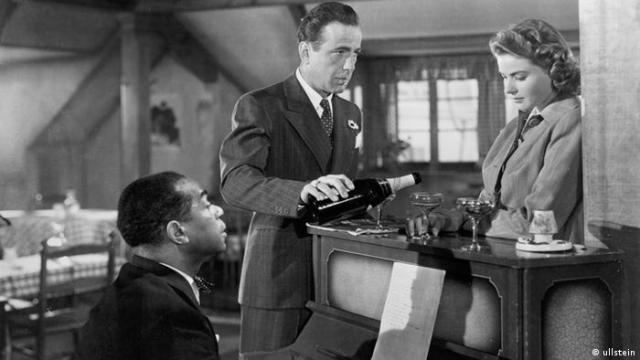
Censorship in picture and synchronous track: only in 1975 did German viewers see the Nazi-critical original of Casablanca
An example: the film classic Casablanca. In the 1942 published in the US original, the place of the event was a warehouse full of refugees from Nazi-occupied Europe. When the film first appeared in Germany in 1952, it was not only reduced by 25 minutes (containing references to the Second World War): the anti-fascist Czechoslovakian resistance fighter who fled from the Nazis had become – by synchronous track – a Swedish scientist who before Interpol was on the run.
After the end of the Cold War, the confrontation of German cinema with the national past was more open. Today's films face history. Of course, the comparison has become easier, since the access to the original versions is actually always given. Changes to the sync text can be quickly identified.

Coveted Trophy: The German Dubbing Award
But still sync can still change a lot on the script, translator Lisa Voigt has to consider, which is responsible for German subtitles and translations. "Synchronous versions may differ significantly from the original," she says, "subtitles, however, have to stand the direct comparison, especially with English-language films, which usually understands the German audience quite well."
On the lip movement exactly
The voice actor scene is proud to practice the utmost care in keeping the lips moving. Sometimes even the original word joke falls victim to this. While the synchronous versions at the text level are edited by the authors in favor of length and emphasis, the dubbing speakers make the lyrics even further during studio recording. In the end there is a compromise.

Actor and speaker Jörn Linnenbröker at the German Synchronization Prize 2019
"Sometimes you have to make a decision to stay as true to the original as possible," says actor and speaker Jörn Linnenbröker, who dubbed series like Mr. Robot and Unbreakable Kimmy Smith and was last heard as Adam Levine in Is not It Romantic.
"Sometimes a tone does not match the mouth movement that corresponds to the exact translation, then the translation is changed a bit to make it look good, of course we want to be as close as possible to the original, but it has to look good as well is the conflict. "

All winners and laudators at the Deutscher Synchronpreis 2019
Behind a dubbed film version is always the effort of many people who work in a very tight time frame to finish the film close to international theatrical release.
This invisible work is celebrated on this evening in Berlin. The many voices that have created the dubbed versions of "The Death of Stalin", "A Star is Born" or "Game of Thrones" get their own stage here.
ليست هناك تعليقات